
The Discourse Is Asking the Wrong Question
October 10, 25: $19 billion in liquidations in a single day. Hyperliquid's ADL mechanism closed $2.1 billion in positions in just 12 minutes. The community response that followed was serious.
Tarun Chitra at Gauntlet published a formal model of ADL, proving a fundamental trilemma under which no policy can simultaneously satisfy solvency, revenue, and trader fairness, and demonstrating that existing mechanisms imposed roughly $650 million in unnecessary haircuts on October 10 alone.
Anatoly Yakovenko published Percolator, a formally verified pro-rata implementation that navigates that trilemma more equitably than existing queue-based approaches.
Some of the most careful investigative work on DeFi exchange mechanics appeared in this period, examining opaque insurance funds, hidden credit extensions, and ADL exemptions stitched together across the industry, and asking real questions that most of the ecosystem was not.
All of this work identified real problems. None of it addressed the root cause.
All discussions, from trilemma proofs to investigative journalism, take place within a narrow, shortsighted framework that assumes ADL liquidation cascades threatening solvency are an unavoidable part of perpetual futures markets, and that risk management can only respond after they happen. In this view, the only remaining questions are about the fairness and efficiency of downstream distribution mechanisms.
These issues have been fully addressed, but they miss the real threat. The fundamental question — the root cause of why the cascade occurred in the first place — has not been explored.
These are like blind men with the elephant in the room, only touching the tail, trying to agree on how to cut it up among the pottery owners present, while overlooking the bigger risk of the elephant growing larger each day.
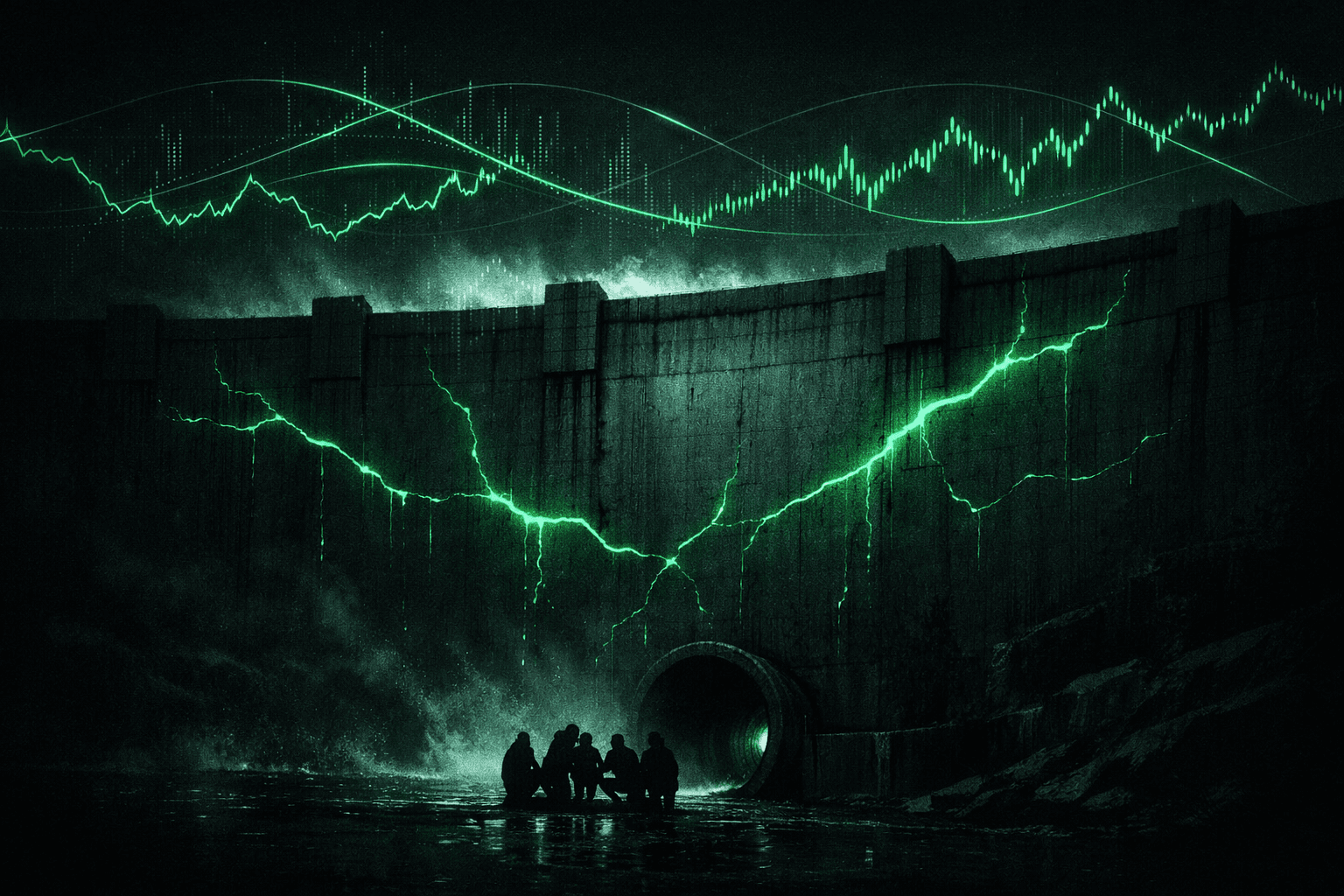
The dam is accumulating pressure. The field is debating drainage.
A Failure Mode With a History
The perpetual futures industry's margin architecture is based on flat-rate, static thresholds set by protocols and fixed until static volatility modeling indicates a change or a major loss occurs — for example, 5% for 20x leverage, whether volatility is high or low; no feedback from current volatility conditions; no awareness of market impact and liquidation costs at the aggregate level; no constraint on total open interest relative to what the underlying markets can actually absorb in a forced liquidation.
This is not a 2015 design problem. It is a pre-1987 intellectual problem, and the world has already watched it fail twice at the civilizational scale.
Before Black Monday in October 1987, portfolio insurance had become the dominant institutional risk management framework. The models assumed markets would remain sufficiently liquid for continuous rebalancing, and that individual hedging actions would not materially affect aggregate outcomes. Between $60 and $90 billion in equity assets were being dynamically hedged on those assumptions.
When selling pressure began, all of them sold simultaneously into a falling market. The feedback loop between concentrated forced selling and market depth was the mechanism that the models had assumed away. The S&P fell 22% in a single day.
Two decades later, banks running VaR under Basel II had calibrated their risk estimates to the low-volatility period of 2003–2006. When 2008 arrived, those models remained anchored to calm-period data. Internal VaR models systematically failed to predict extreme losses.
The core failure was that VaR managed risk as if each institution existed in its own universe, ignoring the systemic effects of correlated decisions at scale. Basel III's subsequent requirement for stressed VaR calibration was a direct admission that static calm-period calibration is structurally inadequate.
Crypto perpetual futures margin architecture is a third instance of the same intellectual failure. The assumption that a fixed percentage threshold adequately represents tail risk across all market conditions is not meaningfully different from the assumptions that failed in 1987 and contributed to the failures of 2008.
The ADL reform debate is optimizing the bankruptcy distribution mechanics of a risk architecture with that genealogy. The dam is accumulating pressure. The field is debating drainage.
The Architecture That Actually Solves This
The Concordia Risk Framework was developed beginning in 2022 for DeFi lending protocols, where the inadequacy of static collateral models was already producing visible failures: the BNB/Venus concentration incident, the Curve/AAVE near-cascade, both following the same pattern of a margin model that accepted concentration far beyond what it could safely liquidate.
The framework addresses the upstream design question through three integrated components: FHS VaR simulation, Concentration Add-on, and Modular Rebalancing.
Filtered Historical Simulation VaR
Long-window historical returns are devolatilized using an EWMA measure to produce the unconditional return distribution — the shape of historical tail risk separated from the volatility regime in which those moves occurred. Those Dvols are then revolatilized against current short-window realized volatility to produce Rvols: a distribution with the tail shape of historical stress events, scaled to today's actual market conditions.
Margin is set to the 99th percentile of the live distribution. The result is a margin engine that tightens automatically as volatility rises and loosens when markets are calm, without requiring a governance vote. This is the feedback mechanism that portfolio insurance lacked in 1987.
Concentration Add-On
A position of $50 million in a liquid instrument and a position of $50 million representing 40% of a token's average daily volume yield identical FHS VaR estimates for a given return distribution, but yield entirely different actual liquidation costs. The Concentration Threshold is the quantity of an instrument tradeable in one day without a material price impact, derived from circulating supply, average daily volume, DEX reserve depth, and existing open interest.
Any position exceeding that threshold times the holding period is an excess quantity that cannot be liquidated without moving the market against itself. The resulting Concentration Charge scales with the square root of the additional liquidation time required. Positions accumulating toward the market's absorptive limit become progressively more expensive to hold. An example is the JELLY attack on Hyperliquid, which becomes economically unfeasible before it is even attempted under this model.
Rolling Rebalancing Modulation
When a portfolio approaches the liquidation threshold, the engine begins winding down the position at the Concentration Threshold daily rate across a predetermined window rather than triggering cliff-edge forced liquidation. No single forced selling event is large enough to create bad debt. No cascade trigger. Aggregate OI is always bounded by what the market can actually clear.
The solvency trilemma exists within ADL mechanism designs, but it misses the core issue: the need for a margin engine that prevents the precondition of exchange insolvency from occurring, thereby mitigating the trilemma's impact and rendering it irrelevant.
Unlike ADL, FHS models are not affected by the trilemma and operate on a more granular, dynamic level, utilizing devolatilized returns and real-time concentration charges to ensure solvency.
Why Solana Has the Opportunity to Build This Correctly
Perpetual futures are the market that completes the Solana financial stack. The ecosystem-wide push toward building them is well-founded. But the question of whether Solana wins perps is less important than what kind of perp market it builds and on what foundation it builds its risk engine.
Every dominant perp exchange, whether decentralized or centralized, inherited the same pre-1987 margin architecture from a design that was never formally evaluated. Hyperliquid built it. dYdX built it. Drift built it. The CEXes it was copied from built it. None of them questioned whether the margin engine was adequate before building everything else around it. October 10 was the invoice for that decision.
Solana is building its perp stack now, from a position where the failure modes are documented, the historical precedents are clear, and the alternative architecture exists and has been formally developed. The opportunity is not just to win the market, but to win it correctly — with a margin engine that does not require governance overrides, validator interventions, or post-hoc ADL reform debates whenever conditions move beyond what a static model assumed.
That is a genuine competitive differentiator for protocols building on Solana, and a genuine reason for institutions to begin taking Solana seriously and choosing it over alternatives.
The technical infrastructure required for on-chain FHS implementation is further along than most people in this conversation realize. Solana's throughput and latency characteristics make continuous on-chain margin recalculation more viable here than in any other major execution environment.
The ecosystem has already built formally verified exchange logic and ZK-proven computation. A decentralized historical data layer for risk model calibration is not beyond current state-of-the-art. It is a milestone on a path the ecosystem is already walking.
What Can Still Go Wrong: The Risks Nobody Is Discussing
The strategic conversation about winning perps on Solana is happening at the ecosystem level. The ADL reform debate is happening at the research and protocol level. Neither is asking the question that most directly threatens to make a well-designed perp market fail anyway.
The reason this question is not being asked is structural and worth naming explicitly. Improving the margin engine does not drive user acquisition in any visible way. Nobody opens a perp trading account because the exchange uses FHS VaR rather than flat-rate margin.
The risk architecture is invisible to users until it fails catastrophically, at which point the damage to the user base is already done. It is the category of infrastructure that does not support growth and becomes relevant only when it threatens to destroy what was built.
Oracle Fragility at Scale
Solana's perp market will depend heavily on price oracle infrastructure. The JELLY incident demonstrated that even a relatively small and illiquid instrument, when combined with inadequate concentration constraints and manipulable oracle inputs, can produce protocol-threatening losses. As Solana's perp OI grows and more long-tail instruments get listed, particularly under permissionless listing frameworks, the oracle attack surface grows with it. A static margin model with no concentration awareness cannot defend against this. An FHS model with a Concentration Add-On calibrated to spot-market depth renders the attack economically unviable at the outset.
The Race to the Bottom
The competitive dynamics of perp markets create persistent pressure toward inadequate margins. As more perp protocols launch on Solana, each will face the incentive to offer higher maximum leverage than its competitors. Higher leverage generates more notional volume from the same deposited capital, which in turn generates more fee revenue, which funds more growth.
Any protocol that voluntarily raises margin requirements to reflect actual risk cedes volume to one that does not. This dynamic does not self-correct. It corrects when a sufficient failure forces it. The only structural defense is either an ecosystem-wide standard that makes dynamic margin the expected baseline, or a sufficiently large failure that makes the static alternative commercially indefensible.
Institutional Credibility
The institutions filing Solana ETFs and building on-chain treasuries will, at some point, carefully review the risk infrastructure underlying the perp markets they are considering participating in. TradFi institutions operate under risk management frameworks that would not permit participation in a derivatives market with no dynamic volatility adjustment and no concentration-aware margin.
The gap between what institutional risk standards require and what crypto perp exchanges currently offer is one of the structural reasons institutional participation in perp markets has remained limited. Solana has an opportunity to close that gap rather than inherit it.
Conclusion
The strategic case for Solana perps is well-made and broadly understood across the ecosystem. The post-October 10 research produced serious and valuable work on real problems. The investigative journalism that documented what existing systems actually do, and asked questions that much of the ecosystem was not asking, deserves credit for surfacing real structural vulnerabilities.
None of it addresses the structural problem. The strategic conversation is about winning a market. The reform debate is optimizing the downstream distribution mechanics of a risk architecture built on pre-1987 intellectual assumptions that have already contributed to two systemic failures at the civilizational scale.
Both conversations are happening simultaneously. Neither is asking whether the foundation itself is sound.
Solana has the execution environment, oracle infrastructure, composable DeFi stack, and institutional momentum to build a perp market that the rest of the industry has not. The Concordia framework provides the margin architecture that enables that.
The question is whether the ecosystem builds it correctly while the opportunity still exists, or inherits the same fragile foundation that the rest of the market is currently attempting to patch.
Every major derivatives crisis has eventually forced the redesign of the risk infrastructure that allowed it. That redesign had never happened before the crisis.
Every major derivatives crisis has eventually forced the redesign of the risk infrastructure that allowed it. That redesign had never happened before the crisis. The perpetual futures ecosystem, on Solana and everywhere else, is building toward an event that will make the current architecture impossible to defend.
The difference is that Solana is building now, and the correct architecture is available now.
The dam does not need better drainage. It needs to be built to hold the water with proper exit values as the water rises.
This piece draws on the Concordia Risk Framework, an adaptive DeFi margin architecture developed during my time at Concordia with my work on dynamic risk infrastructure for DeFi protocols beginning in 2022, grounded in Filtered Historical Simulation VaR, Concentration Add-On, and rolling modulation mechanics derived from CME and professional clearing house methodology.
Nate is the CEO of Turbin3, Solana's leading developer education program, and a former Protocol Researcher and Risk Advisor at Concordia.